dyad.stats.mass_ratio.duquennoy1991
- dyad.stats.mass_ratio.duquennoy1991 = <dyad.stats.mass_ratio.duquennoy1991_gen object>
The mass-ratio random variable of Duquennoy and Mayor (1991)
As an instance of the rv_continuous class,
dyad.stats.mass_ratio.duquennoy1991object inherits from it a collection of generic methods (see below for the full list), and completes them with details specific for this particular distribution.Methods
rvs(loc=0, scale=1, size=1, random_state=None)
Random variates.
pdf(x, loc=0, scale=1)
Probability density function.
logpdf(x, loc=0, scale=1)
Log of the probability density function.
cdf(x, loc=0, scale=1)
Cumulative distribution function.
logcdf(x, loc=0, scale=1)
Log of the cumulative distribution function.
sf(x, loc=0, scale=1)
Survival function (also defined as
1 - cdf, but sf is sometimes more accurate).logsf(x, loc=0, scale=1)
Log of the survival function.
ppf(q, loc=0, scale=1)
Percent point function (inverse of
cdf— percentiles).isf(q, loc=0, scale=1)
Inverse survival function (inverse of
sf).moment(order, loc=0, scale=1)
Non-central moment of the specified order.
stats(loc=0, scale=1, moments=’mv’)
Mean(‘m’), variance(‘v’), skew(‘s’), and/or kurtosis(‘k’).
entropy(loc=0, scale=1)
(Differential) entropy of the RV.
fit(data)
Parameter estimates for generic data. See scipy.stats.rv_continuous.fit for detailed documentation of the keyword arguments.
expect(func, args=(), loc=0, scale=1, lb=None, ub=None, conditional=False, **kwds)
Expected value of a function (of one argument) with respect to the distribution.
median(loc=0, scale=1)
Median of the distribution.
mean(loc=0, scale=1)
Mean of the distribution.
var(loc=0, scale=1)
Variance of the distribution.
std(loc=0, scale=1)
Standard deviation of the distribution.
interval(confidence, loc=0, scale=1)
Confidence interval with equal areas around the median.
Notes
The probability density function for
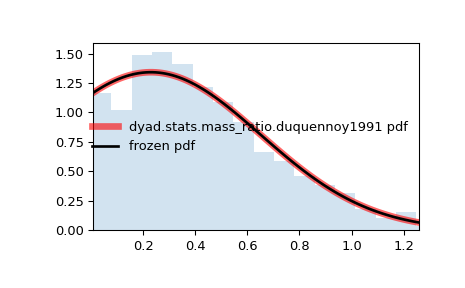
duquennoy1991is:\[f_{Q}(q) = \dfrac{1}{1 - \Phi(0; \mu, \sigma^{2})}\phi(q; \mu, \sigma^{2})\]for mass ratio \(q \in (0, \infty)\) where \(\phi(\cdot; \mu, \sigma^{2})\) and \(\Phi(\cdot; \mu, \sigma^{2})\) are the probability density function and the cumulative distribution function for a Gaussian random variable with mean \(\mu\) and variance \(\sigma^{2}\) and where \(\mu = 0.23\) and \(\sigma = 0.42\).
The probability density above is defined in the “standardized” form. To shift and/or scale the distribution use the
locandscaleparameters. Specifically,mass_ratio.duquennoy1991.pdf(x, loc, scale)is identically equivalent todyad.stats.mass_ratio.duquennoy1991.pdf(y) / scalewithy = (x - loc) / scale. Note that shifting the location of a distribution does not make it a “noncentral” distribution; noncentral generalizations of some distributions are available in separate classes.References
Duquennoy, A., and M. Mayor. 1991. 'Multiplicity among solar-type stars in the solar neighbourhood—II. Distribution of the orbital elements in an unbiased Sample'. Astronomy and Astrophysics 248 (August): 485.
Examples
>>> import numpy as np
>>> import dyad
>>> import matplotlib.pyplot as plt
>>> fig, ax = plt.subplots(1, 1)
Calculate the first four moments:
>>> mean, var, skew, kurt = dyad.stats.mass_ratio.duquennoy1991.stats(moments='mvsk')
Display the probability density function (
pdf):>>> x = np.linspace(dyad.stats.mass_ratio.duquennoy1991.ppf(0.01), ... dyad.stats.mass_ratio.duquennoy1991.ppf(0.99), 100) >>> ax.plot(x, dyad.stats.mass_ratio.duquennoy1991.pdf(x), ... 'r-', lw=5, alpha=0.6, label='dyad.stats.mass_ratio.duquennoy1991 pdf')
Alternatively, the distribution object can be called (as a function) to fix the shape, location and scale parameters. This returns a “frozen” RV object holding the given parameters fixed.
Freeze the distribution and display the frozen
pdf:>>> rv = dyad.stats.mass_ratio.duquennoy1991() >>> ax.plot(x, rv.pdf(x), 'k-', lw=2, label='frozen pdf')
Check accuracy of
cdfandppf:>>> vals = dyad.stats.mass_ratio.duquennoy1991.ppf([0.001, 0.5, 0.999]) >>> np.allclose([0.001, 0.5, 0.999], dyad.stats.mass_ratio.duquennoy1991.cdf(vals)) True
Generate random numbers:
>>> r = dyad.stats.mass_ratio.duquennoy1991.rvs(size=1000)
And compare the histogram:
>>> ax.hist(r, density=True, bins='auto', histtype='stepfilled', alpha=0.2)
>>> ax.set_xlim([x[0], x[-1]])
>>> ax.legend(loc='best', frameon=False)
>>> plt.show()