dyad.stats.argument_of_pericentre
- dyad.stats.argument_of_pericentre = <dyad.stats._argument_of_pericentre_gen object>
The random variabe for the argument of pericentre
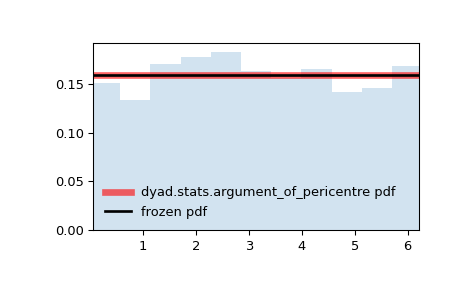
The distribution is uniform on \([0, 2\pi)\).
As an instance of the rv_continuous class,
dyad.stats.argument_of_pericentreobject inherits from it a collection of generic methods (see below for the full list), and completes them with details specific for this particular distribution.Methods
rvs(loc=0, scale=1, size=1, random_state=None)
Random variates.
pdf(x, loc=0, scale=1)
Probability density function.
logpdf(x, loc=0, scale=1)
Log of the probability density function.
cdf(x, loc=0, scale=1)
Cumulative distribution function.
logcdf(x, loc=0, scale=1)
Log of the cumulative distribution function.
sf(x, loc=0, scale=1)
Survival function (also defined as
1 - cdf, but sf is sometimes more accurate).logsf(x, loc=0, scale=1)
Log of the survival function.
ppf(q, loc=0, scale=1)
Percent point function (inverse of
cdf— percentiles).isf(q, loc=0, scale=1)
Inverse survival function (inverse of
sf).moment(order, loc=0, scale=1)
Non-central moment of the specified order.
stats(loc=0, scale=1, moments=’mv’)
Mean(‘m’), variance(‘v’), skew(‘s’), and/or kurtosis(‘k’).
entropy(loc=0, scale=1)
(Differential) entropy of the RV.
fit(data)
Parameter estimates for generic data. See scipy.stats.rv_continuous.fit for detailed documentation of the keyword arguments.
expect(func, args=(), loc=0, scale=1, lb=None, ub=None, conditional=False, **kwds)
Expected value of a function (of one argument) with respect to the distribution.
median(loc=0, scale=1)
Median of the distribution.
mean(loc=0, scale=1)
Mean of the distribution.
var(loc=0, scale=1)
Variance of the distribution.
std(loc=0, scale=1)
Standard deviation of the distribution.
interval(confidence, loc=0, scale=1)
Confidence interval with equal areas around the median.
Examples
>>> import numpy as np
>>> import dyad
>>> import matplotlib.pyplot as plt
>>> fig, ax = plt.subplots(1, 1)
Calculate the first four moments:
>>> mean, var, skew, kurt = dyad.stats.argument_of_pericentre.stats(moments='mvsk')
Display the probability density function (
pdf):>>> x = np.linspace(dyad.stats.argument_of_pericentre.ppf(0.01), ... dyad.stats.argument_of_pericentre.ppf(0.99), 100) >>> ax.plot(x, dyad.stats.argument_of_pericentre.pdf(x), ... 'r-', lw=5, alpha=0.6, label='dyad.stats.argument_of_pericentre pdf')
Alternatively, the distribution object can be called (as a function) to fix the shape, location and scale parameters. This returns a “frozen” RV object holding the given parameters fixed.
Freeze the distribution and display the frozen
pdf:>>> rv = dyad.stats.argument_of_pericentre() >>> ax.plot(x, rv.pdf(x), 'k-', lw=2, label='frozen pdf')
Check accuracy of
cdfandppf:>>> vals = dyad.stats.argument_of_pericentre.ppf([0.001, 0.5, 0.999]) >>> np.allclose([0.001, 0.5, 0.999], dyad.stats.argument_of_pericentre.cdf(vals)) True
Generate random numbers:
>>> r = dyad.stats.argument_of_pericentre.rvs(size=1000)
And compare the histogram:
>>> ax.hist(r, density=True, bins='auto', histtype='stepfilled', alpha=0.2)
>>> ax.set_xlim([x[0], x[-1]])
>>> ax.legend(loc='best', frameon=False)
>>> plt.show()